How many hours of sun will that room get?

Tap the map, get the answer. Sunlight Checker simulates hours of direct sun — shadows from neighboring buildings included — using Japan's official PLATEAU 3D city model and astronomical solar geometry. Free, unlimited, on-device.

iOS 17+ iPhone & iPad Free · unlimited checks No ads, no tracking

The sun over Tokyo right now — computing…

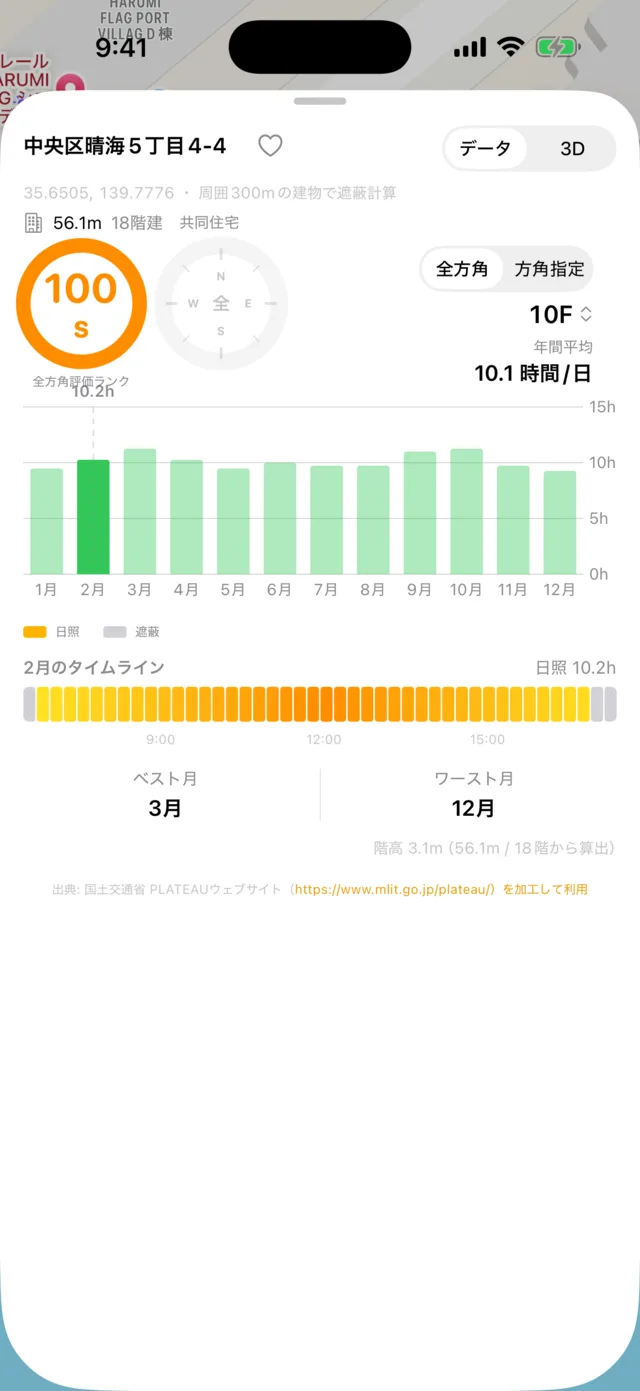
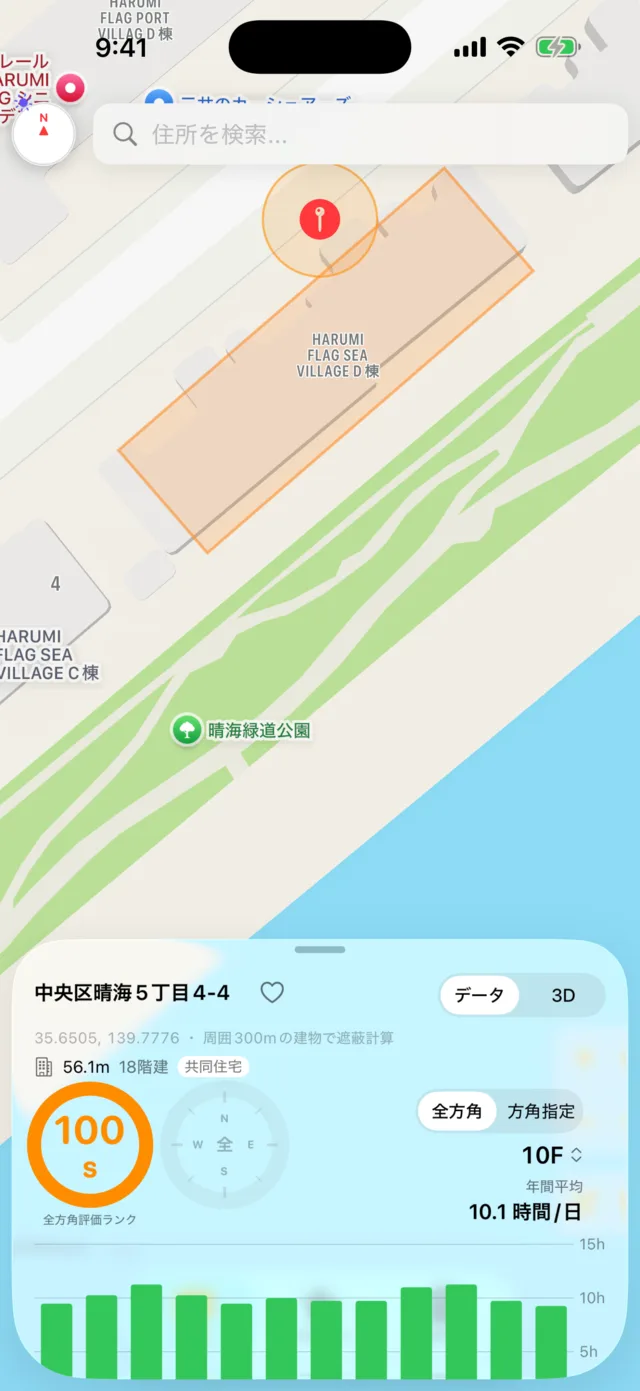
Sunlight Checker result screen — an 18-storey building in Harumi, Tokyo with sunlight score 100, 10th floor, 10.1 hours of sun per day on annual average

Actual app screen (a real building in Harumi, Tokyo)

2s

From tap to result

576

Rays cast per check

12mo

Months of sunlight, charted

0

Location data sent to servers

Viewings happen on sunny afternoons.
Nobody shows you
the winter-morning light.

So we compute it — from real building data and the sun's actual path.

The listing said south-facing, but afternoons were dark

The viewing was bright — by pure luck

Come winter, the building next door swallowed the light

My balcony plants never get enough sun

Tap. Two seconds.

Tap anywhere on the map — or search an address, or use your current location. Sunlight score, monthly chart and floor-by-floor comparison appear on the spot. No real-estate expertise required.

  • Unlimited checks, free
  • Save up to 1,000 favorites and compare locations later
  • Hourly timeline & direction filter PRO
1

Tap the mapAddress search and current location work too

2

Read the resultSunlight score and monthly chart in about 2 seconds

3

Compare floorsSee how 1F differs from 5F, instantly

The whole city, in the math.

Sunlight Checker uses PLATEAU — the official 3D city model maintained by Japan's Ministry of Land, Infrastructure, Transport and Tourism. Neighboring buildings keep their real heights and shapes, and rays are cast from the sun's position to detect shadow (ray casting).

  • Building heights and shapes from surveyed open data
  • Sun position computed from latitude, longitude, date and time
  • All 12 months — solstice to solstice
Rays are cast from the sun to your spot — if one hits a building, that time counts as shade

No servers.

The address you check might be your next home. So Sunlight Checker runs every calculation on your iPhone. Neither the places you search nor your results ever leave the device.

  • No location or search history sent
  • No account, no personal data collected
  • No ad or analytics SDKs
iPhoneEverything computed here
ServerDoesn't exist

The only network traffic is downloading PLATEAU building data. Nothing about you is sent.

See it in action.

Every screen below is a real calculation at a real place — no mockups.

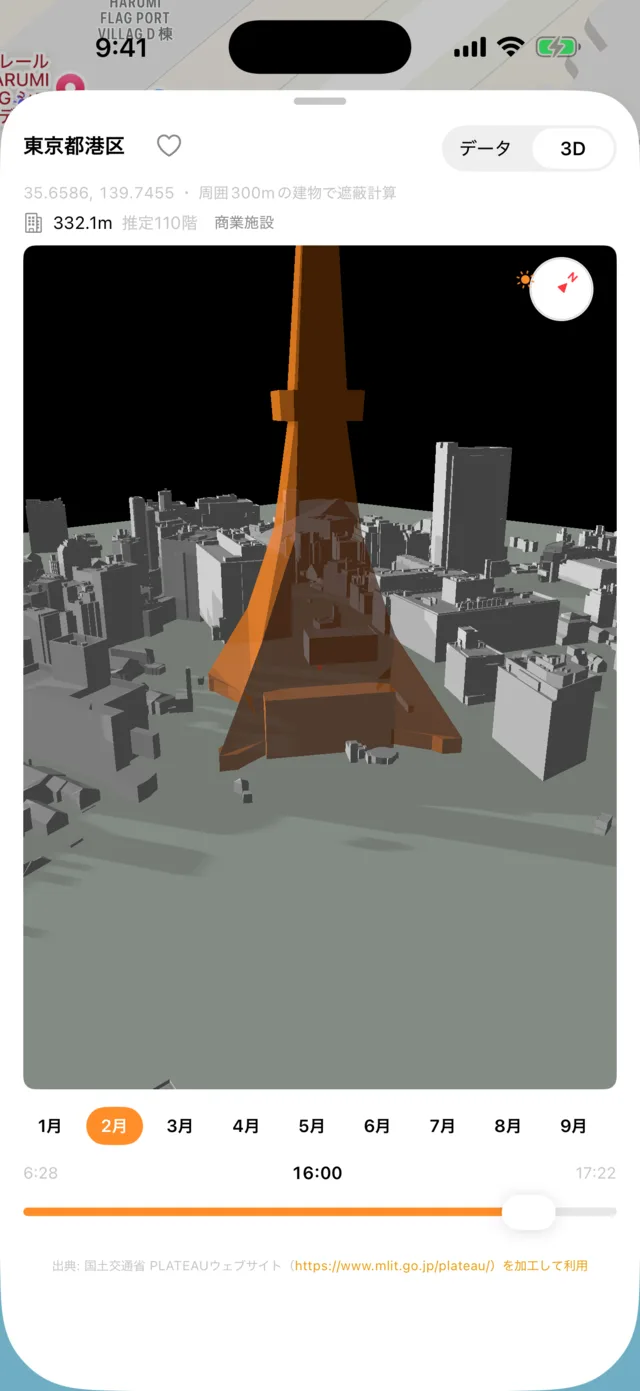
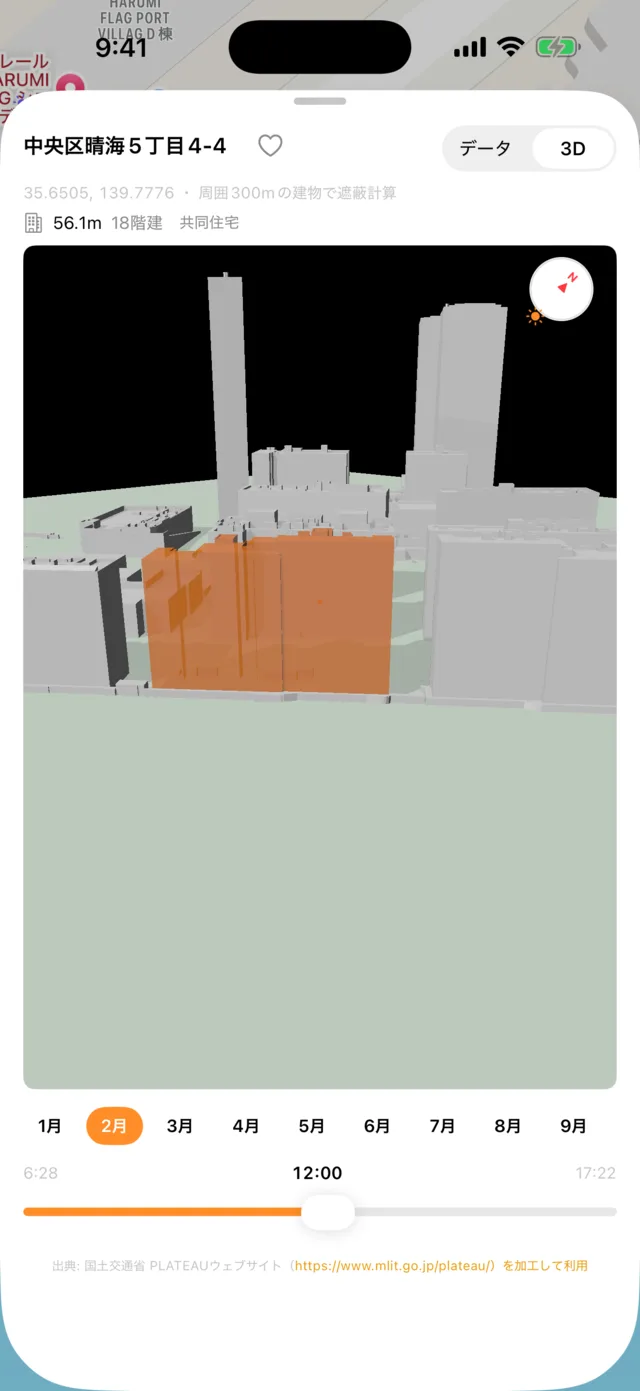
3D view — the Harumi neighborhood rendered from the PLATEAU 3D city model
3D viewInspect building shadows in 3D
Shadow simulation — Tokyo Tower casting its long February-afternoon shadow in 3D
Shadow simulationTokyo Tower in February
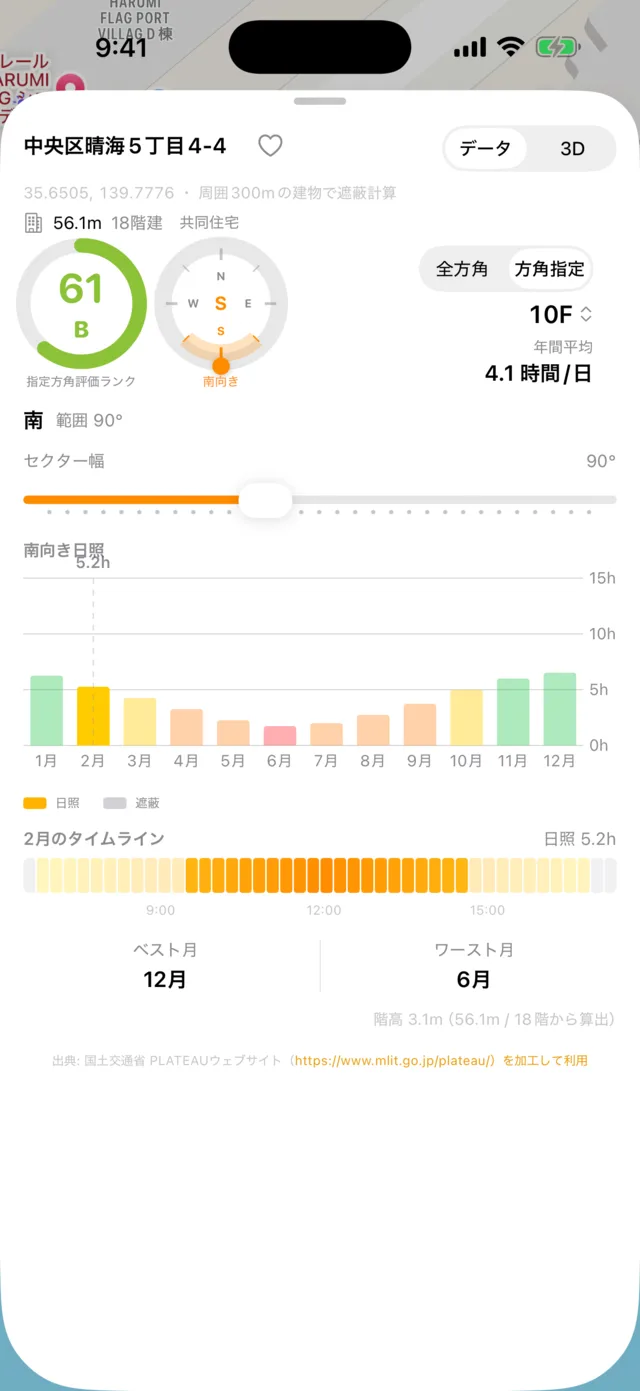
Direction filter — evaluating a south-facing window with compass and sector width
Direction filterRate sunlight by window facing
Monthly chart and hourly timeline — February sunlight in 15-minute steps
TimelineA day of sun, in 15-min steps
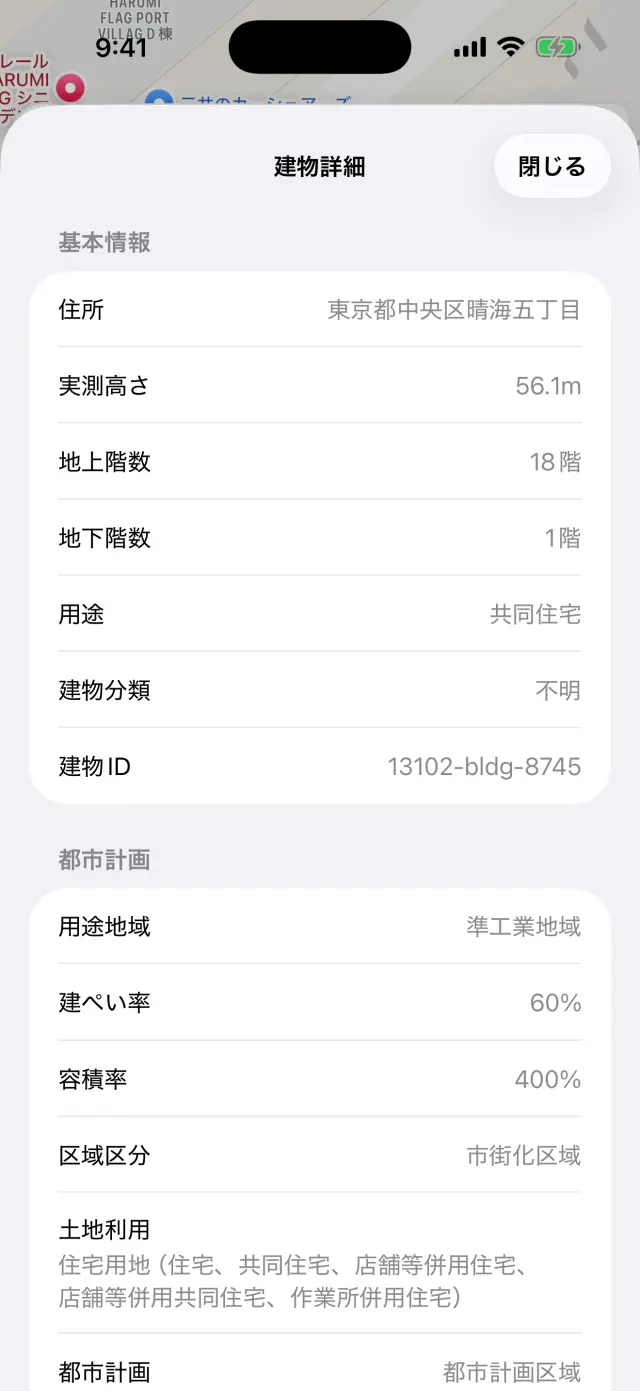
Building details — height, storeys, usage, zoning, coverage and floor-area ratio of an 18-storey Harumi apartment from PLATEAU attributes
Building detailsFull specs in one tap

Reading the results

"Is this number even right?" — real examples, answered. The physics of the sun is written into every figure.

Direction Filter

Ocean-facing but low sunlight?— Harumi tower 10F, 119° facing

The 119° direction faces Tokyo Bay with zero obstruction. But the sun is only in this sector for 4-6 hours in the morning. The annual average of 4.9 hours is close to the theoretical maximum.

How the sun moves

The sun rises from the east (~90°), passes through the south (180°), and sets in the west (270°). It's near 119° (ESE) only from sunrise to around 10-11 AM. Even with zero obstruction, sunlight from the 119° direction is physically limited to 4-6 hours per day.

Monthly data

MonthIn-sector timeNote
Jan4.0hLate sunrise
Apr6.0hBest month
Dec3.8hWorst month
Annual avg5.0hApp shows: 4.9h

Key takeaway

The direction filter measures "sunlight visible from a window facing that direction." Even without obstruction, hours when the sun isn't in that direction aren't counted. Switch to "All directions" to see total sunlight hours.

South-facing means long sunlight?— South (180°), 90° sector width

"South-facing = great sunlight" is conventional wisdom. But the south filter only counts 135°-225°. Morning sun and afternoon western sun are excluded.

South filter range

With south (180°) and 90° sector width, the count range is 135°-225°. The sun is in this range roughly from 10 AM to 2 PM — about 4 hours (winter) to 6 hours (summer).

Comparison with "All directions"

ModeWinter (Jan)Spring (Apr)Summer (Jul)
All directions6-8h9-11h10-13h
South (90° width)3-4h5-6h5-6h

Key takeaway

The direction filter shows "sunlight entering through a window facing that direction." It's perfect for evaluating a south-facing room, but it's a different metric from total sunlight hours.

North-facing: really zero sunlight?— North (0°), 90° sector width

In Japan (Northern Hemisphere), the sun always passes through the south. The sun only reaches the north sector (315°-45°) briefly during summer mornings and evenings. Zero in winter is normal.

The sun doesn't go north

In the Northern Hemisphere, the sun rises from the east, passes through the south, and sets in the west. It only passes through the north sector (315°-45°) just after sunrise and before sunset around the summer solstice.

Monthly data

MonthIn-sector timeNote
Jan0.0hSun never goes north
Jun1.5hEarly morning + evening only
Sep0.0hZero after equinox
Annual avg~0.4hSummer months only

Key takeaway

Even north-facing rooms get sunlight counted in "All directions" mode from east and west. "North-facing ≠ dark all day." However, direct sunlight through a north window is virtually nonexistent.

Floor & Sunlight

1F vs 5F: a huge difference— Floor-level sunlight gap in residential areas

Even surrounding buildings of only 10m can heavily obstruct 1F when the sun angle is low. 5F can clear the obstruction and secure sunlight.

How obstruction works

Sunlight Checker shoots a ray from the observation point (selected floor height) toward the sun direction, checking if it hits surrounding buildings. Lower floors are more likely to be obstructed; higher floors get more sunlight.

Floor comparison example

FloorAnnual avg (all dir.)Winter (Jan)Summer (Jul)
1F~4h~2h~6h
3F~6h~4h~8h
5F~8h~6h~10h

Key takeaway

Use the floor selector to compare different floors — it helps with buying or renting decisions. Pay special attention to winter (Dec-Feb) sunlight hours.

Seasonal Changes

Sunlight reversal between winter and summer— Seasonal gap near high-rise buildings

In summer, the sun is high and building shadows are short. In winter, the sun is low and shadows from southern buildings stretch 2-3x longer. The monthly chart reveals seasonal patterns.

Seasonal sun altitude changes

In Tokyo, the sun's altitude at noon varies dramatically: ~78° at summer solstice vs ~31° at winter solstice. Lower sun angles in winter mean shadows 2-3x longer.

SeasonNoon altitudeShadow length (10m bldg)
Summer solstice (Jun)78°~2m
Equinox55°~7m
Winter solstice (Dec)31°~17m

Reading the monthly chart

Look at the balance between orange (sunlight) and gray (obstruction). V-shape (winter dip) is most common with southern buildings. U-shape (summer dip too) means tall buildings on east/west sides. Flat means minimal obstruction.

Key takeaway

The sunlight score is an annual average, but winter sunlight significantly affects quality of life. Focus on the "worst month" in the monthly chart.
When it helps

From apartment hunting to everyday life — whenever sunlight matters.

Apartment hunting

Check sunlight before renting or buying. Verify an apartment's sun exposure before the viewing.

Gardening

Check sunlight on your balcony or garden. Confirm the hours of sun your plants need to thrive.

Office selection

Verify workspace brightness in advance and find a comfortable environment to work in.

Moving comparison

Compare sunlight at multiple candidate locations. Make data-driven housing decisions.

Understanding sunlight

How sunlight hours shape daily life — and how to read the numbers.

What is sunlight time

Sunlight time refers to the hours during which direct sunlight reaches a location in a day. It indicates the time when the sun is not hidden by clouds, excluding cloudy or rainy days. The impact of shadows from buildings and other obstacles must also be considered.

Why sunlight time matters

Sunlight time affects our daily life in the following ways:

  • Health: Vitamin D production, circadian rhythm adjustment, mental wellbeing
  • Laundry & drying: Faster drying time, mold prevention
  • Utility costs: Reduced heating costs, lower lighting expenses
  • Plant growth: Gardening and houseplant cultivation

Seasonal variations in sunlight

In Japan, sunlight hours are longest during the summer solstice (around June 21) and shortest during the winter solstice (around December 22). In Tokyo, there's approximately a 4-hour difference between summer solstice (about 14 hours) and winter solstice (about 10 hours). When selecting real estate, it's important to consider sunlight hours during the winter solstice when they are at their minimum.

Shadow impact from buildings

Surrounding buildings block sunlight and create shadows. Particularly when there are tall buildings on the south side, sunlight hours are significantly reduced. Sunlight Checker uses PLATEAU 3D city models to perform accurate sunlight simulation considering the height and position of surrounding buildings.

Recommended sunlight hours

According to the Building Standards Act, it is recommended that residential living spaces (living rooms, bedrooms, etc.) ensure at least 4 hours of sunlight on the winter solstice. However, this is not a legal requirement but merely a guideline. Actual comfort varies depending on personal preferences and lifestyle.

Anatomy of accuracy.

Four technologies behind every calculation.

01

PLATEAU 3D city model

High-precision 3D data provided by the Ministry of Land, Infrastructure, Transport and Tourism. Accurately reproduces building shapes, heights, and location information for realistic sunlight simulation.

02

Solar orbit calculation

Accurate sun position calculation based on astronomy. Calculates the sun's azimuth and altitude from latitude, longitude, and date/time, accurately reproducing seasonal and hourly variations.

03

Ray casting

Ray tracing technology in 3D space. Calculates sunlight paths and determines obstruction by buildings, computing accurate sunlight hours considering surrounding environmental impact.

04

On-device processing

All calculations completed within your device. Server-free privacy protection and fast sunlight calculation without external dependencies.

Data source: Processed data from Ministry of Land, Infrastructure, Transport and Tourism PLATEAU website (https://www.mlit.go.jp/plateau/)

Free, and unlimited.

Sunlight checks have no usage cap. When you want to look deeper, there's Pro.

Free plan

¥0

Free forever

  • Unlimited sunlight checks
  • Monthly sunlight chart
  • Floor selector for every storey
  • Up to 1,000 favorites
Popular

Pro plan

¥300/mo

or ¥2,500/year (about 30% off)

  • Everything in Free
  • Hourly timeline
  • 3D shadow visualization
  • Direction filter

Frequently asked questions

Is Sunlight Checker free to use?

Yes, the basic features are completely free. You can use sunlight checks unlimited times without any restrictions. For more detailed analysis, please consider the Pro version (300 yen/month or 2,500 yen/year).

Which areas are supported?

Available in areas where PLATEAU 3D city models are published throughout Japan. Major cities (Tokyo 23 wards, Yokohama, Osaka, etc.) are covered, and we plan to expand coverage in the future.

How accurate is the data?

Using PLATEAU 3D city models from the Ministry of Land, Infrastructure, Transport and Tourism and astronomical solar orbit calculations, highly accurate sunlight simulation is possible. However, please use this as reference information. For important decisions, we recommend consulting experts.

What's the difference with the Pro version?

The Pro version offers advanced features including hourly timeline, 3D shadow visualization, and directional filter. The free version also supports all floors and up to 1,000 favorites.

Is personal information collected?

No. Sunlight Checker uses a server-zero architecture, and all data processing is completed within your device. We do not collect personal information (name, email address, phone number, etc.).

How is sunlight time calculated?

We calculate the sun's position using astronomical solar orbit calculations, then perform ray casting (ray tracing) using PLATEAU 3D building data to calculate sunlight hours considering the impact of surrounding buildings.

Is building height considered?

Yes. PLATEAU 3D city models include building height information, and we accurately simulate the shadow effects based on the height of surrounding buildings. You can check sunlight for any floor using the floor selector.

Pick your next home
by its sunlight.

Free, with unlimited checks. Start with that apartment you've been eyeing.